The Brushwork of Monet (and the Tragedy of Photographing Paintings)
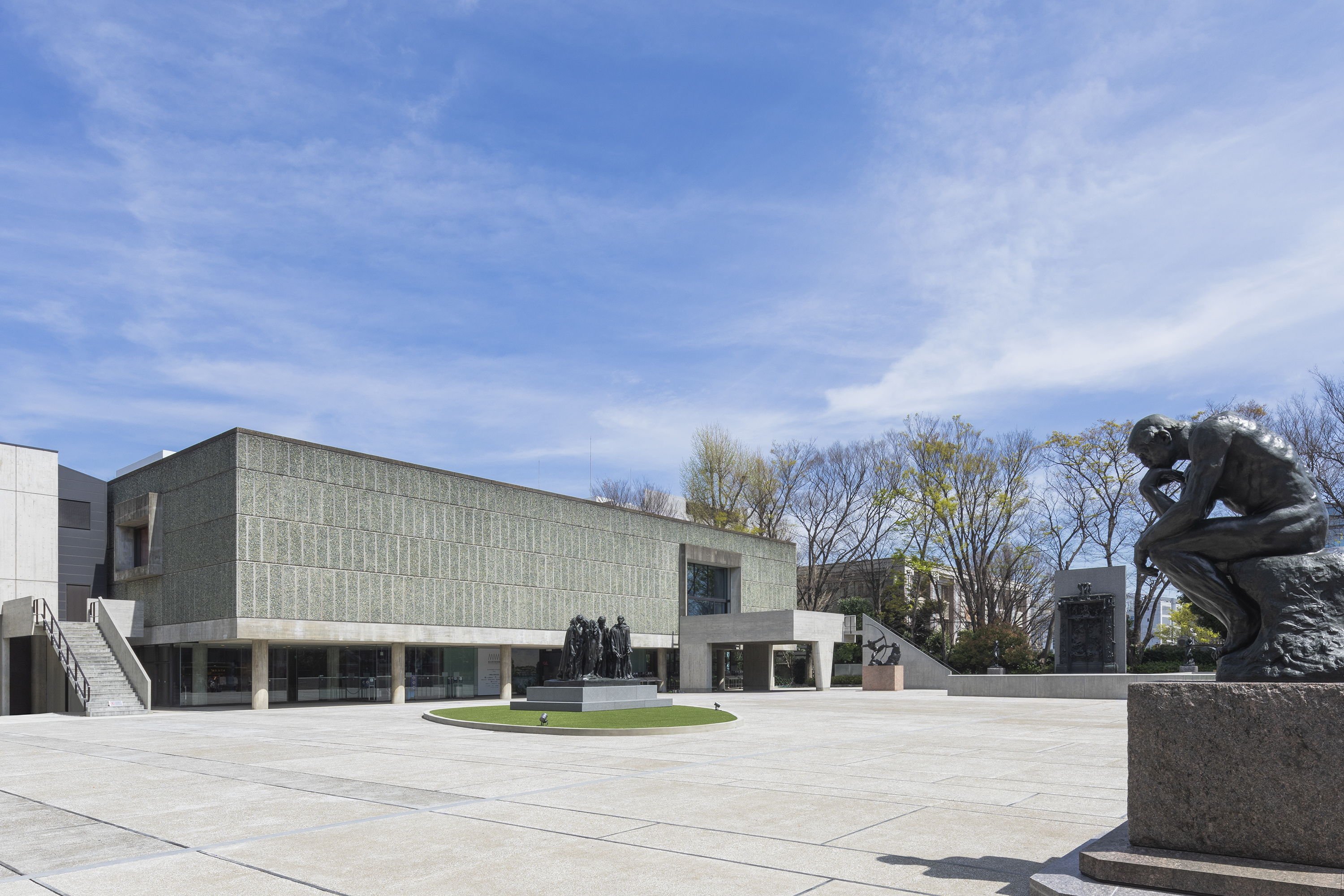 |
| The Tokyo Western Museum of Art (minus the 1000 people lined up outside) |
To be honest, I wasn't sure what to expect going in. Monet is perhaps one of the most famous artists of all time. Maybe I'm just a hipster, but whenever it comes to popular artists I always fight a moment of doubt. Is the acclaim really worth it? Time and time again, my bias is disproved when I actually see the works in person; however, I'd like to talk about that bias for a minute, because I don't think it's just me.
I first came face to face with this bias when I had the opportunity to see Van Gogh's Sunflowers in person for the first time several years ago. Of course, I had seen the painting before many times before in photos. In my home growing up we had a reproduction of it hanging at the top of our staircase, so it's no exaggeration to say I saw it daily. To be honest, I didn't think much of Sunflowers- I just thought, hey, people like flowers. That's why its popular. Or maybe people are just enthralled by Van Gogh's life story, and that colors their perception of his art. Something like that.
Then, I saw it in person. I was completely blown away. It was absolutely nothing like the painting I thought I knew. The application of paint, brushwork, things that couldn't be conveyed in reproductions or photography held the soul of the painting. Standing in front of it, you'd think some sunflowers done in bright warm colors would be happy painting, but in person it was unmistakably depressing. I immediately understood why he is hailed as a genius and why the tragic story of his life resonated with so many people. He was able to capture emotion in his art with haunting sensibility.
Photography often creates this problem of setting our expectations before we see something in person. Modern photography has become so high-resolution and so accessible that its tempting to think it's analogous to experiencing real life. But it isn't! Putting art photography aside, how many times have you been surprised by false expectations set from photos? Then you visit a natural world wonder like the Grand Canyon and think, "Wow. This doesn't look the same in a photo at all." Or, for that matter, the dilemma of trying to photograph a full moon, or the sunset on your phone camera…
 |
| A photograph of Tokyo from a plane at night. It looked better in person, you'll just have to trust me. |
You haven't seen a painting until you've seen it. I relearn this lesson every time I visit a museum. The most recent shocking experience I had with this was seeing work by Jean-Honoré Fragonard (1732-1806). Frankly, before then I thought he was overrated. Then, I saw his work in person, and he instantly became one of my favorite painters. His charcoal drawings and use of line in particular have a sensibility reminiscent of John Singer Sargent, a style that many modern portrait painters aspire to emulate. His work feels really modern.
 |
| "Happy Lovers" at the Norton Simon, CA. Truly, Rococo was the anime of the 1700s |
 |
| amazing leg! |
 |
| 40 minute sketch I did, trying to pay attention to his use of overlaps and these little stylistic triangles of value he puts in that are almost like inking |
(I actually went into the museum bookstore and looked at prints of his work afterwards just to verify my fears. It's truly awful how bad the reproductions are. What a shame!! Terrible, just terrible!)
Ahem.
Anyway, to summarize what I'm trying to say here: even though we know that photography doesn't fully capture life, our expectations are inevitably colored by seeing photos. There are many aspects of paintings which do not transmit over to the photographs taken of them. While keeping that in mind, and with the aim to observe what could only be observed in person, I entered the exhibit. Below is my analysis.
Two disclaimers: First, this Monet exhibition was focused on his lily paintings. So, my observations in this article are based on those, his paintings from later life. Second, I won't be talking about color. I know color is like Monet's whole thing, but I only had about 4.5 hours in the exhibition before I ran out of juice. You have to choose your battles.
As an artist and art enthusiast I'm used to marveling at art done by masters. Feeling out of your depth when admiring paintings is normal, but even so, you can still learn. Thoughts like,
"Wow, Fragonard uses small triangles of dark value throughout his paintings. I guess it's to emphasize overlaps. Hey, that's almost like inking! And his colors are so anime- this feels so modern!"
or
"Bouguereau uses harder edges around the silhouette of his figures while his interior shapes use softer edges. His figures look so clean and soft at the same time. I guess that's why his work feels more real than real life."
Stuff like that.
Not so with Monet. At least, not at first. For the first hour I was very lost. Sure, there was the obvious. The first thing that jumps out about Monet's compositions is that he groups his values well.
 |
| the two foreground boats are the dark value group. everything else is a lighter value group. you can see this easily if you squint your eyes, the background just blurs together |
The study looked like a schematic. That immediately seemed at odds with the spontaneity I saw in all his other paintings. How do you plan while still being spontaneous? Furthermore, there were some strange things going on in the study. The shapes of the painting were all clearly laid out, sure, but his brushwork was totally weird. It was filled with shorthands that looked overly complicated, even random. I focused on those for some time. Looking at shorthands, the things an artist repeats over and over, is a good place to start your analysis. It's usually an indicator of what they concern themselves with most.
Eventually a specific brush stroke jumped out at me. Here's a sketch from my notes.
 |
| Unfortunately, I wasn't able to take a photo. |
This is the shape of the brush stroke. I'm not even joking.
I actually laughed out loud. What the hell are you doing, Monet? Okay, I get it, you can do whatever you want and the painting still looks good. Chill out. It seriously looks like you just went "Euughh! I'll just block in the value here, whatever!! Take this noodle shape or something, it doesn't matter!"
My first thought was that he was simply having fun. I imagined how he held the brush and made that squiggle. He was probably putting his whole body into it, feeling it out as he put it down, really enjoying the feeling of putting paint on canvas. That's something any artist can relate to, and moreover, making marks by intuition is definitely a mark of an impressionist. But here's no way that mark was doing anything functional, right?
Then I looked at the completed Water Lilies painting. The EXACT same brush stroke was there. I looked back and forth, comparing the brushwork between the two paintings. There were variations owing to spontaneity between the two, but sure enough, everything, even the really weird, really long brushstrokes carried over from the study. All those lines, the funny squiggles. Even the things that looked utterly random were planned meticulously. I began to sweat slightly.
How was he doing it? The thing about randomness is you can't replicate it. Whatever these shorthands were doing was responding to a design problem that Monet considered and then devised a solution for. They were necessarily functional, not just for fun or style points (ok, maybe some were for style points). Furthermore, there was a metric he was using to evaluate the functionality of his strokes which I didn't understand. I started to see similar strokes, extremely complicated zig-zags appearing everywhere in Monet's work. The use was ubiquitous, a stylistic solution to a problem he had developed over years of practice.


Flow:
Areas of directional brushwork. They guide the eye in a particular direction.
Rest:
Areas of relatively flat and non-directional brushwork. They are areas where the eye can rest, or areas to glue together the areas of flow and noodle. They are typically more blended and less impasto. In some of his very impasto paintings, especially in his later life, the areas of rest become very chaotic- however, they remain subdominant to areas of flow and noodle.
Noodle:
Areas where Monet traps your eye with complicated brushwork. He does some truly crazy shit here. I call it noodle because of the looping, doubling-back, sometimes zig-zagging shapes. They are essentially interruptions in the flow of the painting in a way that absorbs your eye and spits it back out again. They add notable weight to the piece and almost always happen at the focal point. What is good noodle and what is bad noodle was likely a matter of great focus to Monet when he was painting.
Observations suggest that flow, rest, and noodle are relatively balanced throughout the painting. Flow seemed to take up the highest percentage of surface area on average. Furthermore, the interplay between flow and noodle changes from piece of piece. In some paintings the flow goes around the noodle just like water. In some paintings the flow leads you into a perpendicular noodle, lending a more dramatic effect. In some paintings the noodle is thrown on like a shorthand for adding weight to balance the composition, especially in his looser works.
Noodle is a very simple technique but Monet was clearly a master of it. The short time I had in the exhibition wasn't long enough to get an intuitive understanding of good noodle. However, I imagine it's something that leads the eye in, traps it for the the right amount of time, and leads gracefully back into the greater flow of the piece. At its core noodle is a composition shorthand technique, a way to add information density, a stylization Monet ran with and enjoyed exploring the limits of. As a final aside, I note that there is a composition concept in Eastern painting similar to this. In Japanese it is called 情報量 (jyou-hou-ryou) and literally means "amount of information." It's a classic Eastern design principle derived from ink painting that essentially juxtaposes areas of high information density to low density via composition and mark-making. I'm not sure how much Monet sought to replicate this aesthetic but it's no secret he admired Japanese ink works. He imported and referenced them and no doubt analyzed their composition. His noodle technique may have been conceived in part as a way to bring Eastern inking aesthetic into oil painting.
Rather than using value or edge to create focal points, you can use noodle-like patterns to trap the eye. This seems especially valuable as a technique during layins or quicksketch. One function of noodle is kind of a shorthand for focal point. Noodle had overlap with impasto and some 3d effects, but it had 2d logic behind it as well. You could noodle in charcoal or digital or in many painterly styles. Two important things to consider may be: 1) how the eye enters the noodle, and 2) how the eye leaves the noodle and re-enters the greater flow of the composition.
Monet used flow, rest, and noodle to organize simple compositions. Because he was always aware of how the viewer's eye would interact with the piece, he had a great command over a viewer's attention, something every artist should care deeply about. Simple is good. Also, he used the entire canvas, finding areas of rest even in relatively active areas near the focal point. Areas of rest were supporting cast members to flow and noodle that glued the painting together.
Thanks for reading.

Comments
Post a Comment